Structural Formula
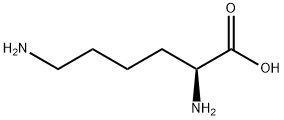
| Name | L-Lysine |
| Synonyms | laiansuan; ArginineImpurity1 (ArginineEPImpurityA) (Lysine); ArginineEPImpurityA; L-Lysinecrystallized, >=98.0% (NT); )reagentgrade,>=98%;NEODIMIUMSTAND;L-Lys-OH |
| CAS No. | 56-87-1 |
| Molecular Formula | C6H14N2O2 |
| Molecular Weight | 146.19 |
| EINECS No. | 200-294-2 |
| Melting Point | 215°C(dec.)(lit.) |
| Specific Rotation | D20+14.6°(c=6.5); D23+25.9°(c=2in6.0NHCl) |
| Boiling Point | 265.81°C (Chemical book rough estimate) |
| Density | 1.1360 (roughestimate) |
| FEMA | 3847|L-LYSINE |
| Refractive Index | 26°(C=2,5mol/LHCl) |
Uses 1. Lysine is mainly used in food applications as flavor enhancers in milk powder, children’s health care products, and nutritional supplements (mainly used to strengthen L-lysine), because the odor is less than that of L-lysine Chemicalbook acid salt Salt, so the effect is better. 2. Lysine can be used as a flavoring agent. Used in alcohol, soft drinks, bread, starch products, etc. 3. Lysine can be used as a business additive.